
Suit Stitching in Jodhpur – A Complete Guide to Fabric, Fit, Fittings and Finish

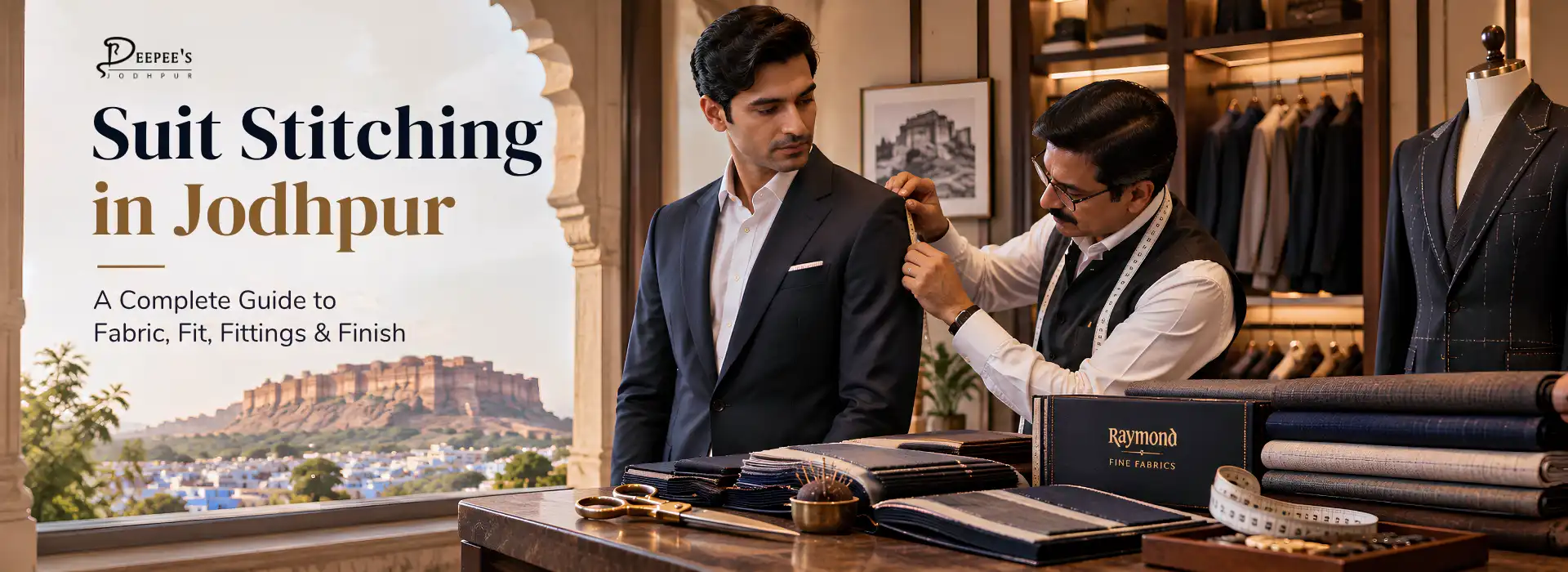
If you wear suits regularly, getting one stitched shouldn’t feel like a project you need to manage.
You shouldn’t have to arrive knowing tailoring terminology, spend hours comparing technical details or supervise every decision from fabric to final fitting. You should be able to explain what you need the suit for, how often you’ll wear it, what you generally like and approximately what you’d like to spend.
The rest is where a good tailor earns your trust.
For professionals, executives, businessmen, government officers and men who dress formally as part of their working life, suit stitching in Jodhpur should ultimately solve a very simple problem: getting a suit that looks appropriate, feels comfortable through a long day and can be worn confidently without demanding too much thought.
Here’s what you actually need to know before getting one made.
Quick Answer: How Does Suit Stitching Work?
Getting a suit stitched generally begins with deciding where and how often you'll wear it, followed by fabric selection, measurements, style preferences, tailoring and fittings. A good suit tailor should guide you through these decisions rather than expecting you to understand the technicalities. If you're getting a professional suit made, comfort, repeat wear and versatility should matter as much as appearance.
First, Tell Your Tailor What the Suit Is For
This is the most useful information you can provide.
“I need a suit” isn’t quite enough.
Is it going to be your regular professional suit? Something you wear for important meetings? A suit reserved for conferences and formal functions? Something versatile enough to work across business and social occasions?
The answer changes what should be recommended.
A professional who wears a suit several times every month usually needs something understated, dependable and comfortable enough for extended wear. Someone commissioning a suit primarily for formal occasions has more freedom to prioritise finer fabrics, distinctive textures or a more occasion-oriented appearance.
You don’t need to translate those requirements into tailoring decisions yourself.
Simply explain your life.
A good tailor should translate your requirement into the garment.
Then Comes the Fabric
For many customers, this is where the process becomes unnecessarily confusing.
A suiting collection can contain dozens—sometimes hundreds—of options. Colours that appear nearly identical can feel completely different. Prices vary considerably. There are different fibres, blends, finishes and fabric weights.
You don’t need to understand all of them.
Instead, tell the person helping you:
- what you’re making,
- how frequently you’ll wear it,
- whether you generally work indoors or move around,
- the colours you prefer,
- and your approximate budget.
That information should narrow the selection considerably.
At Deepee’s, customers can explore an extensive range of Raymond fabrics in Jodhpur, from practical professional suitings to premium and luxury options. If you’re looking for a suit for regular work, we’d approach the selection differently from a garment being commissioned for an important formal occasion.
And the most expensive fabric isn’t automatically the correct answer.
A fabric that feels beautiful but doesn’t suit the way you actually live in your suit isn’t a particularly good investment.
What Fabric Works Well for a Professional Suit?
There isn’t one universal answer.
For regular professional wear, the objective is generally to balance appearance, comfort, durability and ease of repeat wear.
Wool and suitable wool blends can work particularly well for structured professional tailoring, while other quality blended suitings may make sense for customers prioritising durability, practicality or a particular budget.
Jodhpur’s climate matters too.
If you regularly move between indoor and outdoor environments, fabric weight and comfort deserve more attention than they might for someone spending almost the entire working day in air-conditioned spaces.
This is precisely why choosing fabric by a photograph, brand name or price alone isn’t ideal.
Tell us how you intend to wear it.
Then choose.
How Much Fabric Do You Need for a Suit?
You don’t need to calculate this before visiting.
The amount required depends on factors such as your measurements, the width of the fabric, whether you’re making a two-piece or three-piece suit and certain design choices.
Tell the fabric seller or tailor exactly what you’re planning to make and let them determine the appropriate quantity.
Buying too little creates an obvious problem.
Buying substantially more than required simply wastes good cloth.
This is one of those details that shouldn’t be your problem to solve.
Do You Need to Know Exactly What Style You Want?
No.
If you already know that you prefer a two-button navy suit with a particular lapel and trouser style, that’s useful.
If you don’t, that’s completely normal.
For professional clothing, we’d generally begin with your working environment and existing wardrobe rather than whatever silhouette happens to be trending.
If this is your first serious professional suit, versatility usually matters more than novelty.
Navy, charcoal and grey are useful starting points because they work across a broad range of shirts, ties and professional settings. Once those foundations are covered, your wardrobe can become more expressive.
The same principle applies to styling.
You don’t need to know the names of every lapel, pocket or trouser detail. Tell your tailor whether you prefer classic, contemporary, conservative or slightly more distinctive.
A competent tailor should take it from there.
Measurements Shouldn’t Feel Like an Examination
- You stand.
- The tailor measures.
- That’s largely your job.
You don’t need to know whether your shoulders are uneven, whether your posture requires an adjustment or why a previous jacket never seemed to sit correctly.
But there is something useful you can tell your tailor:
what has bothered you about previous suits.
Perhaps jackets often feel tight when you sit. Maybe trousers tend to slip. Perhaps you dislike very slim silhouettes. Maybe sleeves on ready-made suits are consistently too long.
Those observations are valuable because they’re based on how clothes actually feel on you.
Technical diagnosis is the tailor’s responsibility.
The Fitting: What Should You Actually Check?
Again, don’t turn yourself into an inspector.
The simplest question is: Does this feel right?
- Sit down.
- Walk around.
- Button the jacket.
- Move your arms naturally.
- Put your phone and wallet where you normally carry them.
If this is a professional suit, imagine spending an entire working day in it rather than standing in front of the mirror for five minutes.
You shouldn’t feel restricted.
The trousers shouldn’t require constant adjustment.
The jacket shouldn’t make you eager to remove it as soon as you sit down.
And visually, the overall impression should feel composed rather than forced.
There may be technical adjustments the tailor notices during the fitting that you never would.
That’s fine.
That’s exactly why you’re using a tailor.
How Long Does Suit Stitching Take in Jodhpur?
There isn’t one universal timeline.
Turnaround can depend on the tailoring house, workload, garment complexity, fabric, number of fittings required and whether you’re commissioning something straightforward or highly customised.
If you need the suit for a particular meeting, ceremony, conference or event, mention the date before placing the order.
Don’t wait until halfway through the process to introduce a deadline.
And wherever possible, don’t leave an important suit until the last minute.
Good tailoring benefits from enough time for the garment to be made, tried and adjusted if necessary.
How Much Does Suit Stitching Cost?
Just as there isn’t one Raymond fabric price, there isn’t one universal suit-stitching price.
The final cost can vary according to the tailoring service, construction, garment type, level of customisation and additional requirements.
Rather than evaluating tailoring entirely by the lowest stitching charge, consider what you’re actually receiving.
If you wear a suit regularly, a garment that fits comfortably and gets worn repeatedly can offer considerably more value than something cheaper that remains in the wardrobe because you never quite feel right in it.
For professionals in particular, cost per wear matters more than cost on the invoice alone.
Can You Bring Your Own Fabric for Suit Stitching?
This depends on the tailoring establishment, so it’s worth confirming before visiting.
Equally, you don’t necessarily need to get fabric and tailoring from the same place.
For example, customers can purchase Raymond fabric from Deepee’s without using Deepee’s tailoring service. If you already have a tailor you trust, you are welcome to choose your fabric and take it with you.
On the other hand, if you’re looking for both fabric and suit stitching in Jodhpur, handling the two together can make the process considerably simpler. The fabric can be selected with the finished garment already in mind, and you don’t have to coordinate between different places.
The choice is yours.
If You’ve Recently Moved to Jodhpur, Don’t Rebuild Your Wardrobe at Once
- A new posting or relocation doesn’t mean you need five new suits immediately.
- Start with what your professional life actually requires.
- If you already own several suits, perhaps all you need is a dependable local tailor for future garments.
- If your wardrobe needs updating, begin with one versatile suit—often navy or charcoal—and see how the experience goes.
- If the fabric works, the suit feels right and you trust the people handling it, your next garment becomes easier.
- Then you can gradually add another suit, separate trousers, a blazer or more formal pieces depending on your professional calendar.
- Find the right place first. Build the wardrobe later.
Why Professionals Benefit From Having a Regular Tailor
The biggest advantage may not be the first suit.
It may be the fourth.
Once a tailor understands how you like your clothes, future decisions become considerably easier.
You don’t need to repeatedly explain that you dislike very narrow trousers. You don’t need to rediscover which jacket shape feels comfortable. You already know which colours and fabrics have worked for you.
That continuity is particularly useful for professionals who need formal clothing regularly but don’t want clothing to consume much of their time.
Eventually, ordering another garment can become less about shopping and more about simply solving a wardrobe requirement.
- “I need another pair of trousers like the grey ones.”
- “I need a navy suit slightly more formal than my last one.”
- “I need something for an official dinner next month.”
That’s how a useful relationship with a tailor should work.
Frequently Asked Questions
When choosing suit stitching in Jodhpur, look for a tailoring service that understands professional requirements, can guide you on appropriate fabrics and provides fittings rather than expecting you to manage technical decisions yourself. Deepee’s offers men’s suit tailoring alongside an extensive Raymond fabric selection.
Deepee’s Jodhpur offers both Raymond fabrics and men’s tailoring, allowing customers to choose their fabric and have the complete suit made through the same place.
No. You can purchase Raymond fabric from Deepee’s and take it to your preferred tailor. Tailoring at Deepee’s is optional.
Timelines vary depending on the tailor, garment, workload, customisation and fittings required. If you need the suit for a particular date, discuss your deadline before placing the order.
You don’t need technical tailoring knowledge. Know what you’re making, where you’ll wear it, how frequently you’ll use it, your general style preferences and approximate budget. Your tailor should guide you through the remaining decisions.
Navy, charcoal and grey are versatile choices for professional wardrobes. The best option depends on your profession, existing clothing and the situations in which you expect to wear the suit.
No. Fabric should be appropriate for the garment’s purpose, frequency of wear, climate and budget. Fit and tailoring also significantly influence how good the finished suit looks and feels.
It isn’t necessary, but it can be convenient. Selecting fabric and tailoring together allows both decisions to be made with the finished garment in mind. If you already have a trusted tailor, however, you can simply purchase your preferred fabric separately
Conclusion
Raymond Fabrics and Suit Stitching at Deepee’s Jodhpur
At Deepee’s, our main Jodhpur store brings together fabric selection and men’s tailoring. Customers can explore Raymond suitings across accessible, premium and luxury categories and decide how they’d like to proceed.
Need fabric only? Choose it and take it with you.
Already own fabric and need tailoring? Discuss your requirement with our team.
Need a complete suit? Select the fabric and have the garment made through Deepee’s.
For professionals, the conversation doesn’t need to begin with tailoring terminology.
Tell us:
What do you need?
Where will you wear it?
How often will you wear it?
What do you want to spend?
We’ll take the conversation from there. Because if you’re looking for suit stitching in Jodhpur, you shouldn’t have to become an expert in suits. You should simply end up with one that works.
Visit our fabric store at 2nd Polo, Paota C Road, Jodhpur (Raj.). For fabric enquiries, pricing and custom tailoring, call +91 9530123489.
Choose your preferred fabric and have your suit customised to your fit and style.