
How Many Suits Does a Working Professional Actually Need?

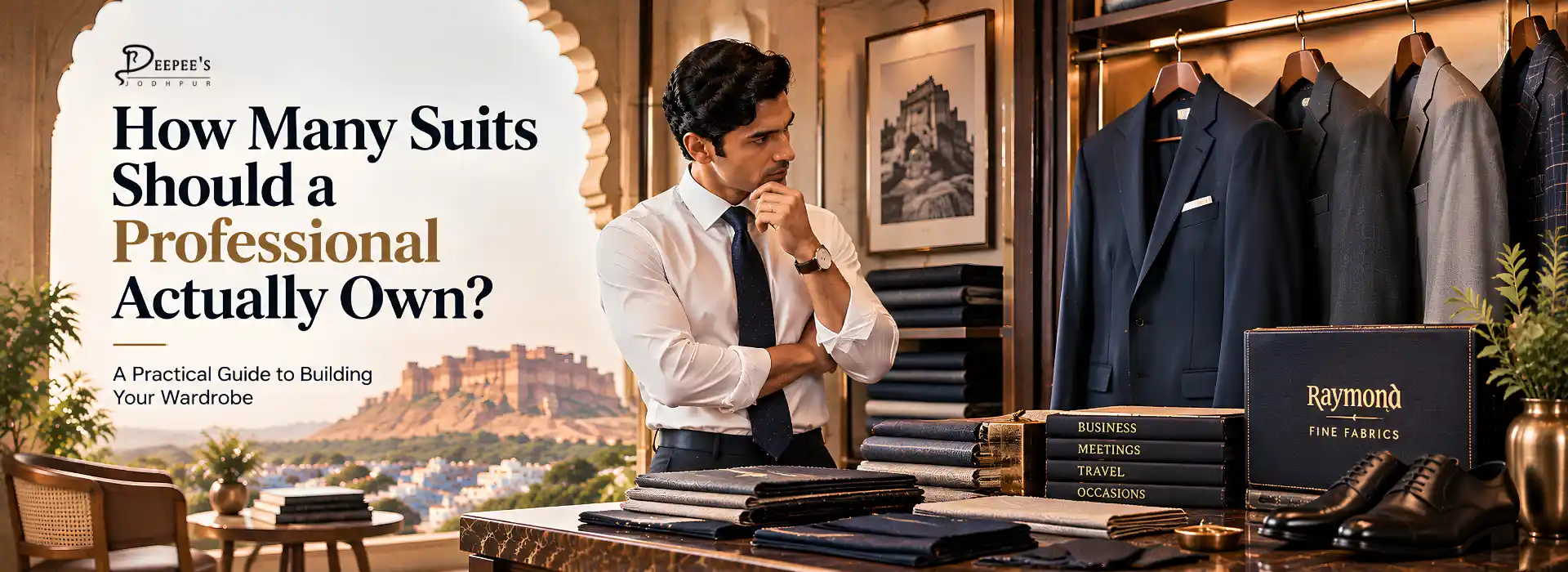
There is a point at which buying another suit stops making your wardrobe better.
Most professionals don’t need a cupboard full of them. What they need is a small, dependable rotation that covers an ordinary workday, an important meeting, a formal function and the occasional situation that appears on the calendar with very little warning.
So, how many suits should a man own?
The answer isn’t three, five or seven. It depends almost entirely on how often you actually wear them.
For government officers, executives, businessmen and other professionals who dress formally with some regularity, the smarter question is:
How many suits do I need so that getting dressed for work never becomes a problem?
Let’s answer that without turning your wardrobe into another project.
Quick Answer: How Many Suits Should a Professional Own?
If you wear suits only occasionally, one or two versatile suits may be enough. If you wear them once or twice a week, three well-chosen suits can provide a useful rotation. If formal clothing is a regular part of your profession, a broader wardrobe of suits, separate trousers and blazers becomes more practical. The right number depends on frequency of wear, professional environment and how often your clothes need to be cleaned or rested.
The goal isn't to own the most suits.
It's to never feel as though you have nothing appropriate to wear.
If You Wear a Suit Only Occasionally
You probably don’t need an extensive collection.
If suits come out primarily for important meetings, conferences, formal dinners, official functions or occasional events, one excellent versatile suit can do a surprising amount of work.
Navy is an obvious starting point.
It can look appropriately professional during the day, become more formal with the right shirt and tie, and work across enough situations that it rarely feels like the wrong choice.
Charcoal is another strong option, particularly if your professional environment tends to be more conservative.
If you own two suits, we’d generally prefer them to be meaningfully different rather than two slightly different versions of the same navy.
One navy.
One charcoal or grey.
For many men who only occasionally need formal Western clothing, that may genuinely be enough.
If You Wear a Suit Once or Twice a Week
This is where a little more rotation becomes useful.
You don’t necessarily want to wear the same suit every time you’re required to dress formally, and repeatedly wearing the same garment without giving it time between uses isn’t ideal either.
A practical starting wardrobe might include:
- A navy suit
Your most versatile option. - A charcoal suit
Slightly more sober and particularly useful for formal professional settings. - A medium grey or subtly textured suit
Something that expands the wardrobe without becoming difficult to repeat.
Three suits already create significantly more variety than the number suggests because shirts, ties and shoes change the overall appearance. The mistake is assuming variety requires buying dramatic suits.
It doesn’t.
For professional dressing, repeatable is often more valuable than memorable.
If Suits Are Part of Your Regular Working Life
Now the calculation changes.
If you wear suits several times a week, you need enough rotation that no individual garment is doing all the work.
But even here, we’d hesitate to prescribe an arbitrary number like “every professional needs seven suits.”
Your actual requirement depends on your schedule.
Someone who wears a suit every working day needs a different wardrobe from a government officer who wears one primarily for meetings, inspections, official ceremonies and particular engagements.
Instead of chasing a number, think in terms of coverage.
- Do you have something dependable for an ordinary professional day?
- Something appropriate for an important meeting?
- Something more formal when the occasion demands it?
- Enough rotation that the same suit isn’t being worn continuously?
If yes, your wardrobe is doing its job.
If not, identify the gap before buying anything else.
Start With Navy
If you’re building a professional wardrobe from scratch, navy deserves its reputation.
It is formal without feeling severe, works across seasons and pairs easily with white, blue and many subtly patterned shirts.
More importantly, it repeats well.
That’s important.
An unusual suit might receive more compliments the first time you wear it, but everyone remembers it the fifth time.
A good navy suit can appear repeatedly without feeling repetitive.
For officers and professionals who need their clothing to communicate polish rather than fashion-consciousness, that’s a considerable advantage.
If you are commissioning your first serious professional suit, navy is difficult to regret.
Then Add Charcoal
Once navy is covered, charcoal is an excellent second step.
It feels authoritative, works particularly well in conservative professional environments and gives you enough visual difference from navy without requiring a completely different wardrobe of shirts and accessories.
It also moves comfortably between ordinary business settings and more serious formal occasions.
Between navy and charcoal, most professionals already have the foundations of a very capable suit wardrobe.
The third purchase is where your actual lifestyle should begin influencing the decision.
Maybe you need a lighter grey.
Perhaps a subtle check.
Perhaps another navy in a different texture because you wear navy constantly.
There is no rule requiring your third suit to be adventurous.
Before Buying Another Suit, Ask Whether You Actually Need Trousers
This is one of the easiest ways to build a more useful professional wardrobe.
You may not need another complete suit at all.
A few pairs of well-tailored trousers can dramatically increase the number of combinations available to you.
- Charcoal trousers.
- Medium grey trousers.
- Perhaps navy.
Combined with shirts, knitwear in cooler weather and appropriate jackets, they can cover many professional days when a full suit isn’t required.
This is especially relevant in Jodhpur, where wearing a complete suit every day may not always make sense for the climate or the working environment.
Sometimes the smartest tailoring order isn’t: “Make me another suit.”
It’s: “I need two trousers that work with what I already own.”
A Blazer Can Do More Work Than a Fourth Similar Suit
If your professional environment allows separates, a good blazer can become one of the hardest-working garments in the wardrobe. It sits between a full suit and shirt-and-trousers dressing.
That makes it useful for meetings, business dinners, conferences, travel and professional situations where you want to look considered without appearing overly formal.
Again, this is why wardrobe building should begin with situations rather than quantities.
If you already own three good suits but repeatedly encounter occasions where a suit feels too formal and a shirt alone feels too casual, your next purchase probably shouldn’t be a fourth suit.
It should solve the missing middle.
Don’t Buy Five Versions of the Same Suit
Most men have a comfort zone.
Once they find a colour or style they like, they naturally return to it.
There is nothing wrong with that.
But if your wardrobe contains five dark navy suits that serve essentially the same purpose, you haven’t really created five options.
You’ve created one option five times.
Before commissioning something new, look at what you already own.
Ask:
- What can I wear to an ordinary meeting?
- What do I wear when the occasion is more formal?
- What works when I don’t need a full suit?
- What do I wear in warmer conditions?
- Is there anything in my wardrobe I avoid wearing? Why?
The answers will tell you more about your next purchase than a list titled “Ten Suits Every Man Must Own.”
Your Suits Need Rest Too
If you wear tailored clothing regularly, rotation isn’t only about avoiding repetition.
It also gives garments time between wears.
Suits don’t generally need to be dry-cleaned after every use—in fact, unnecessary dry cleaning can be hard on clothing over time. Often, allowing a suit to air properly, brushing it when appropriate and storing it correctly is more useful after an ordinary wear.
Having a rotation means you aren’t forced to reach for the same suit again the following morning.
This is another reason someone wearing suits frequently benefits from owning more than someone who dresses formally twice a month.
Not because he needs more fashion.
Because he needs more function.
Spend More on the Suits You Wear More
If you’re deciding where to allocate your wardrobe budget, frequency is a useful guide.
The suit you wear repeatedly deserves attention.
That doesn’t necessarily mean choosing the most luxurious fabric available. It means investing sensibly in fabric, fit and tailoring that can cope with the amount of use you’re expecting from it.
At Deepee’s, our Raymond fabric collection includes options across practical, premium and luxury categories.
Someone building a professional rotation may prefer to invest in durable, comfortable fabrics for frequently worn suits and reserve finer or more luxurious options for garments intended for less frequent, more important occasions.
That’s often more intelligent than applying the same budget to every suit in the wardrobe.
Spend according to use, not simply occasion.
What About Bandhgalas and Jodhpuri Suits?
For professionals living in Rajasthan, a formal wardrobe doesn’t necessarily end with Western suits.
There are occasions where a well-made Bandhgala or Jodhpuri suit may be more appropriate—or simply more distinctive—than another two-piece suit.
Official functions, formal dinners, weddings and ceremonial occasions can all create opportunities for traditional Indian formalwear.
So if you already have navy, charcoal and grey adequately covered, your next useful formal garment may not be another Western suit at all.
It may be something that expands the kind of occasions you’re prepared for.
A good wardrobe isn’t a collection of suits.
It’s a collection of answers.
Recently Moved to Jodhpur? Don’t Replace Everything
If you’ve been transferred or relocated to Jodhpur, bring your existing wardrobe into the equation.
There is no reason to commission several new suits simply because you’re now living in a different city.
Wear what you already own.
Notice what works in your new routine and what doesn’t.
Perhaps Jodhpur’s climate makes some of your previous suits less practical. Maybe your new role involves more formal functions. Perhaps you discover you need additional trousers rather than additional jackets.
- Give yourself time to understand the requirement.
- Then fill the gaps.
- If you need a new suit, start with one.
- If you need a local source for fabric, explore your options.
- If you need a new tailor, establish that relationship gradually.
Moving cities doesn’t require rebuilding your wardrobe. It requires adapting it.
So, How Many Suits Do You Actually Need?
Here’s the simplest answer.
- If you wear suits occasionally: One or two versatile suits may be enough.
- If you wear them once or twice a week: Around three good suits can create a useful rotation.
- If suits are a frequent part of your professional life: Build enough rotation for your schedule, then add trousers, blazers and other formalwear according to the gaps in your wardrobe.
But don’t treat those numbers as rules.
A man with two excellent suits, four useful trousers and a good blazer may have a far more functional professional wardrobe than someone with eight suits he rarely enjoys wearing.
The better measure is this:
When something appears on your professional calendar, do you already own something appropriate to wear?
If the answer is usually yes, you probably have enough.
Frequently Asked Questions
There is no fixed number. One or two versatile suits may be enough for occasional wear, while someone wearing suits once or twice a week may benefit from around three. Professionals who wear formal clothing more frequently should build a larger rotation according to their actual schedule.
Navy is one of the most versatile choices for a first professional suit. Charcoal is another strong option, particularly for more conservative or formal working environments.
If your first suit is navy, charcoal or medium grey is generally a useful second choice because it expands your options while remaining easy to wear professionally.
Not necessarily. Separate trousers and a versatile blazer may expand your wardrobe more effectively than repeatedly adding similar suits. Build according to the situations you actually encounter.
This depends on use and conditions, but suits generally benefit from time between wears. A rotation is particularly useful for professionals who wear formal clothing frequently.
Not automatically. For frequent wear, comfort, durability, fit and suitability may be more valuable than simply choosing the most expensive fabric available.
Deepee’s Jodhpur carries Raymond suitings across practical, premium and luxury categories for professional and formal wardrobes. Fabric can be purchased independently or combined with Deepee’s tailoring service.
Deepee’s offers men’s tailoring in Jodhpur for professional suits, trousers, blazers and other formalwear, alongside its Raymond fabric selection.
Conclusion
Building a Professional Wardrobe at Deepee’s Jodhpur
For more than four decades, Deepee’s has worked with men’s tailoring and formalwear in Jodhpur. Our main store offers an extensive selection of Raymond fabrics across different requirements and budgets, alongside tailoring for suits, trousers, blazers, Bandhgalas, Jodhpuri suits and other formal clothing.
You can purchase fabric independently if you already have a tailor you trust.
You can bring your tailoring requirements to us if you already have fabric.
Or you can choose the fabric and have the complete garment made through Deepee’s.
But whichever route you choose, we’d rather begin with:
“What does your wardrobe actually need?”
than:
“What would you like to buy today?”
Because the goal isn’t to own more suits.
It’s to own enough of the right ones.
Visit our fabric store at 2nd Polo, Paota C Road, Jodhpur (Raj.). For fabric enquiries, pricing and custom tailoring, call +91 9530123489.
Choose your preferred fabric and have your suit customised to your fit and style.