

Raymond Suiting Fabric Price – What Determines the Cost of Your Fabric?

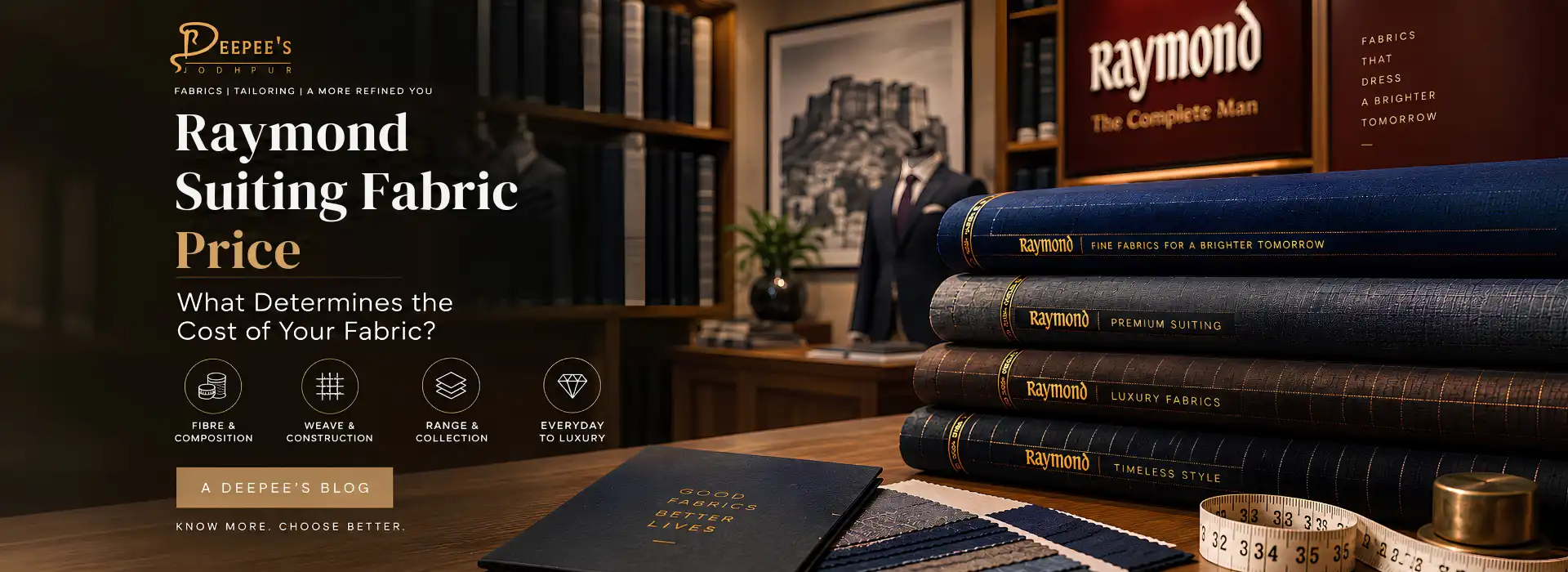
If you’ve ever searched for Raymond suiting fabric price, you’ve probably discovered something confusing: there isn’t one. One Raymond fabric may feel like a straightforward purchase for a pair of office trousers, while another can belong firmly in the luxury category. Both carry the same Raymond name, yet their composition, fineness, construction, finish and intended use can be very different.
That’s because you’re not paying for a brand name alone. You’re buying a particular cloth. At Deepee’s Jodhpur, our Raymond collection ranges from more accessible options for everyday and professional wardrobes to premium and luxury fabrics for customers looking for something exceptional. Understanding what changes between those categories can help you spend where it actually matters—and avoid paying more simply because you assume expensive automatically means better.
Why Do Raymond Fabric Prices Vary So Much?
Think about cars from the same manufacturer. Sharing a badge doesn’t make every model identical. Suiting works similarly. Within Raymond’s portfolio, you’ll encounter different fibres, blends, yarn qualities, constructions and finishes. Some fabrics are engineered around practicality and repeated use. Others prioritise softness, fineness, drape or luxury.
Several factors can influence the price of Raymond suiting fabric, including:
- fibre composition,
- wool content and quality,
- fineness of the fibres,
- yarn and weave,
- fabric construction,
- finishing,
- special performance characteristics,
- and the particular collection or range.
This is why comparing two fabrics purely by price per metre doesn’t necessarily tell you which is the better purchase.
You first need to know what you’re buying it for.
Fibre Composition Changes the Price—and the Fabric
Start with what’s actually inside the cloth.
A practical blended suiting and a fine wool-rich fabric are fundamentally different products. Introduce premium fibres such as silk or increasingly fine wool, and the character of the cloth changes again. Different compositions influence softness, breathability, durability, drape, maintenance and appearance.
But this doesn’t mean that pure or expensive fibres automatically win. For someone making trousers for frequent office use, resilience may be more valuable than extraordinary softness. For someone commissioning a special occasion suit, a finer cloth with a more luxurious hand may justify the additional investment.
Price makes more sense once purpose is clear.
What Do Super 120s, Super 130s and Super 140s Mean?
This is one of the most misunderstood areas of premium suiting.
You’ve probably seen fabrics described as Super 120s, Super 130s, Super 140s and beyond. The natural assumption is that these numbers work like scores—the higher the number, the better the fabric.
That’s not quite right.
In wool suiting, Super classifications relate to the fineness of the wool fibre according to established textile standards. As you move into finer categories, the resulting cloth can feel exceptionally soft and refined.
That refinement can also influence price.
But there’s an important distinction:
Finer does not automatically mean more durable.
An exceptionally fine fabric may be magnificent for a suit worn on important occasions, while a more robust fabric can make considerably more sense for someone who wears suits regularly.
So if someone tells you simply to buy the highest Super number your budget permits, we’d disagree.
Buy according to use.
Affordable Raymond Fabric: Where Does It Make Sense?
Affordable doesn’t have to mean compromised.
For garments expected to work hard—office trousers, regular formalwear, uniforms or a first professional wardrobe—practical Raymond blends can offer an attractive balance of appearance, performance and cost.
These are fabrics where considerations such as durability, crease recovery and maintenance can carry more weight than extraordinary fineness.
They’re particularly relevant for someone who might say:
“I need something good, but I’m going to wear it often.”
That’s a perfectly sensible requirement.
In fact, spending intelligently on everyday clothes can often matter more than spending extravagantly on clothes that rarely leave the wardrobe.
When Does It Make Sense to Move Into Premium Fabrics?
Premium fabrics become interesting when you’re asking more from the appearance and feel of the garment.
Perhaps you’re commissioning an important business suit. Perhaps you already own the basic navy and charcoal options and want something more refined. Or perhaps you’re creating a Bandhgala or blazer that won’t be subjected to the same frequency of wear as your everyday trousers.
This is where differences in hand-feel, drape, construction, texture and fibre quality become more noticeable. A premium cloth doesn’t need to shout that it’s premium. Often, you notice it in subtler ways: how it falls from the shoulder, how the trousers move, how the surface responds to light and how the garment feels after several hours of wear.
What Makes a Luxury Suiting Fabric Expensive?
- At the luxury end, fabric becomes as much about refinement as utility.
- Finer wool, premium blends, sophisticated constructions, specialist finishing and fibres such as silk can move cloth into a completely different category.
- Raymond’s upper-end textile portfolio includes exceptionally fine wool constructions and luxury blends designed for customers who value precisely these qualities.
- This category makes the most sense when the garment itself deserves it.
- A milestone suit. A wedding ensemble. A beautifully cut Bandhgala. A piece you intend to keep rather than replace.
- Luxury cloth isn’t necessary for every garment in your wardrobe.
- That’s precisely what makes it special when you do choose it.
Does More Expensive Fabric Make a Better Suit?
Not by itself.
Fabric is one component of a suit. An important one—but still only one.
Take extraordinary cloth and cut it poorly, and you’ll have an expensive suit that doesn’t sit correctly. Take an appropriate fabric and combine it with excellent pattern-making, cutting, construction and fittings, and the result can look considerably more refined.
This is why we prefer thinking about a suit as a combination of: Fabric + Fit + Construction + Finishing.
Increasing the budget for one while neglecting the others isn’t necessarily the smartest way to spend.
The right question isn’t: “What’s the most expensive Raymond fabric you have?”
It is: “What’s the best fabric for the suit I’m trying to make?”
How Much Should You Spend on Suit Fabric?
There isn’t one correct number. A better way to set your fabric budget is according to the role the garment will play.
- Everyday Professional Wear
Prioritise durability, comfort and cost per wear. A sensible blended fabric may be a better investment than something extremely delicate. - Important Business Wear
Consider moving into a more refined fabric with stronger drape, hand-feel and finish while retaining enough practicality for professional use. - Occasional Formalwear
Because frequency of wear is lower, you have greater freedom to prioritise fineness, texture and visual refinement. - Weddings and Milestone Occasions
Premium and luxury fabrics become particularly relevant when the garment itself is intended to feel exceptional.
Instead of setting one budget for every suit, build a wardrobe in layers.
Fabric Price and Suit Price Are Not the Same Thing
- This distinction is important.
- When you purchase Raymond fabric, you’re paying for the cloth.
- Tailoring is a separate service.
- The final cost of a made-to-measure or bespoke garment can depend on its construction, design, complexity, fittings and finishing in addition to the fabric itself.
- This also means something many customers don’t initially realise:
- You can buy Raymond fabric from Deepee’s without purchasing our tailoring service.
- Choose the cloth you like, purchase the required quantity and take it to your preferred tailor if that’s what you’d rather do.
- If you want Deepee’s to take the fabric forward into a finished garment, that option is available too.
- One does not obligate you to choose the other.
Why We Don’t Recommend Choosing Fabric by Price Alone
- Imagine two fabrics.
- The first costs less but is comfortable, durable and ideal for the trousers you’ll wear twice a week.
- The second costs considerably more and feels exceptionally luxurious, but you’re hesitant to wear it regularly.
- Which represents better value?
- For your everyday wardrobe, probably the first.
- Now imagine you’re choosing the fabric for your wedding Bandhgala.
- The answer may reverse.
- This is why price without context tells you surprisingly little.
- Cost per wear, occasion, longevity and enjoyment all matter.
- Sometimes spending more is worth it.
- Sometimes it isn’t.
- Knowing the difference is where good fabric buying begins.
Why Compare Raymond Fabrics in Person?
- Fabric is unusually difficult to judge through a screen.
- Photography can show colour and pattern reasonably well, but it struggles to communicate weight, texture, softness, drape and movement.
- Even colour can change according to lighting and the display you’re viewing it on.
- When you compare fabrics physically, differences that seem insignificant online become much clearer.
- You can feel the transition from practical to premium. You can compare similar shades. You can see how a fabric moves rather than simply how it photographs.
- And you can decide whether the difference is worth paying for to you.
Explore Raymond Fabrics Across Different Price Categories at Deepee’s Jodhpur
If you’re comparing Raymond suiting fabric prices in Jodhpur, Deepee’s gives you the opportunity to explore the range rather than beginning with a predetermined category.
- Tell us what you’re making.
- Tell us how often you’ll wear it.
- Tell us your budget.
- And then compare.
Our Raymond selection extends across accessible, premium and luxury fabrics, allowing customers to find cloth appropriate for everything from everyday professional wardrobes to important occasions. Once you’ve chosen, you can take the fabric to your own tailor or continue with Deepee’s tailoring for the complete fabric-to-garment experience.
Because the best value isn’t necessarily the cheapest fabric—or the most expensive. It’s the fabric you still believe was the right choice after you’ve worn the garment a hundred times.
Frequently Asked Questions
Raymond suiting fabric does not have one fixed price. Prices vary according to fibre composition, wool content, fineness, construction, finish, collection and other characteristics. It is best to compare fabrics according to the garment you’re making and your intended usage.
Yes. Raymond offers fabrics across multiple categories rather than operating exclusively in luxury suiting. Customers can explore practical options for regular wear as well as premium and luxury fabrics.
Higher-priced fabrics may use finer wool, premium fibres, more sophisticated blends, specialist constructions or luxury finishing. However, higher price does not automatically make
Conclusion
Explore Raymond Suiting Fabrics in Jodhpur
Looking for the right Raymond suiting fabric in Jodhpur at a price that fits your requirements? Explore Deepee’s range of quality suiting fabrics in different textures, finishes and materials, and get expert guidance to choose the right fabric for your suit. Visit our fabric store at 2nd Polo, Paota C Road, Jodhpur (Raj.).
For fabric enquiries, pricing and custom tailoring, call +91 9530123489. Choose your preferred fabric and have your suit customised to your fit and style.