

From Desert to Durbar – The Untold Evolution of Men’s Royal Wear in Rajasthan

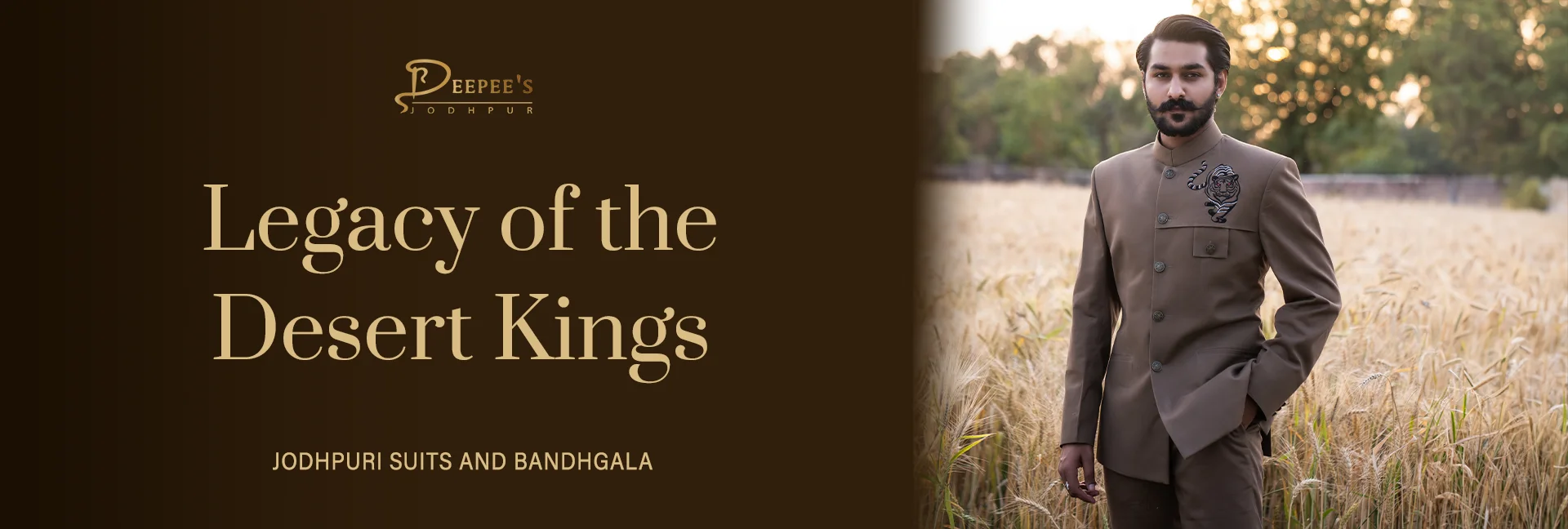
Introduction: Where the Desert Wrote Its Own Dress Code
Rajasthan is not just a land of forts and palaces.
It is a land where survival shaped style—and over time, style became identity. Long before fashion became seasonal and trend-driven, clothing in Rajasthan was functional, symbolic, and deeply personal. The desert demanded resilience. The courts demanded dignity.
Somewhere between the harsh sun and the grandeur of durbars, a unique language of menswear was born—one that continues to define Indian royalty even today. And at the heart of this evolution lies a story few truly understand.
The Desert as the First Designer
Before there were royal courts, there was the desert.
Extreme heat, dry winds, and vast open landscapes shaped how men dressed:
- Loose silhouettes for ventilation
- Layered garments to protect from temperature shifts
- Natural fabrics that allowed the skin to breathe
Early forms of angarkhas and layered robes were not aesthetic choices—they were survival tools. But Rajasthan has always had a way of turning necessity into elegance.
Even the simplest garments carried:
- Thoughtful draping
- Functional layering
- Subtle detailing
This was the beginning of what we now call Rajasthani heritage wear.
The Rise of Royal Courts: When Clothing Became Status
As kingdoms flourished and royal courts emerged across cities like Jodhpur, Jaipur, and Udaipur, clothing began to evolve beyond function.
It became a marker of:
- Rank
- Power
- Identity
Structured silhouettes started replacing purely functional drapes.
This is where garments like the achkan and later the bandhgala began to take form.
The introduction of:
- High collars
- Front-buttoned structures
- Tailored fits
…signaled a shift from survival dressing to command dressing.
In the durbars, what you wore wasn’t just seen—it was interpreted.
The Mughal Influence: Refinement Meets Structure
The evolution of Rajasthani menswear cannot be understood without acknowledging the influence of Mughal aesthetics.
When Rajput and Mughal cultures intersected, a new design language emerged:
- Cleaner cuts
- Intricate embroidery
- Richer fabrics like silk and brocade
The achkan became more refined.
The bandhgala began to resemble its modern form.
But what makes Rajasthan unique is this:
It absorbed influence without losing identity.
Even today, Rajasthani couture carries both:
- Indigenous strength
- External refinement
Jodhpur: The Silent Capital of Menswear Legacy
Among all cities, Jodhpur quietly became a center for structured menswear.
Often referred to as the birthplace of the Jodhpuri suit, the city developed a reputation for:
- Precision tailoring
- Strong silhouettes
- Royal aesthetics
Here, clothing was never just stitched—it was constructed.
Generations of artisans passed down:
- Cutting techniques
- Fabric understanding
- Fit philosophy
This is why even today, when someone searches for authentic Rajasthani menswear, Jodhpur naturally enters the conversation.
From Royal Courts to Modern Weddings
While kingdoms faded, the language of royal dressing did not. It found a new stage—the Indian wedding.
Today’s groom, knowingly or unknowingly, steps into a legacy:
- The bandhgala echoes royal discipline
- The achkan reflects timeless elegance
- The detailing carries forward centuries of craftsmanship
But there is a difference.
Where once clothing was dictated by lineage, today it is chosen by identity. Modern men are not just wearing tradition.
They are interpreting it.
The Shift: From Heaviness to Intentional Elegance
This is where true Rajasthani couture stands apart from mass-produced fashion.
For a while, Indian menswear leaned heavily into:
- Excessive embroidery
- Over-layering
- Visual loudness
But a shift is happening.
There is a growing appreciation for:
- Clean silhouettes
- Refined detailing
- Thoughtful craftsmanship
A return to what royal dressing originally stood for:
Presence without noise.
Preserving the Legacy in a Modern World
The biggest challenge today is not creating new designs. It is preserving authenticity in an age of replication.
True heritage wear requires:
- Understanding of history
- Mastery of tailoring
- Respect for proportion and structure
Very few brands in India operate at this intersection of heritage and precision.
And this is where Deepee’s Jodhpur finds its place—not as a trend-driven label, but as a continuation of a legacy that began in the courts of Rajasthan.
Conclusion: Wearing More Than Just Fabric
When you wear a bandhgala or an achkan today, you are not just wearing a garment.
You are wearing:
- The resilience of the desert
- The discipline of royal courts
- The evolution of centuries
Rajasthani menswear is not about dressing up.
It is about stepping into something larger than yourself.
And the question is no longer what to wear.
It is—what story do you want to carry forward?
Frequently Asked Questions
Traditional Rajasthani menswear includes garments like angarkha, achkan, bandhgala, and safa, designed for both function and royal aesthetics.
Jodhpur is known for its heritage tailoring techniques, structured silhouettes, and its association with the iconic Jodhpuri suit.
An achkan is usually longer and slightly more traditional, while a bandhgala is more structured and modern in appearance.
Authentic Rajasthani bandhgalas are best sourced from heritage-driven brands in Jodhpur, such as Deepee’s Jodhpur, known for precision tailoring and craftsmanship.
Conclusion
Experience Authentic Rajasthani Couture with Deepee’s Jodhpur
At Deepee’s Jodhpur, 2nd Polo, Paota C Road, Jodhpur (Raj.), every piece is rooted in the legacy of Rajasthan and crafted for the modern man who values both heritage and individuality.
Under the guidance of celebrity designer Abhishek Trivedi, Deepee’s Jodhpur has emerged as a trusted destination for those seeking authentic Rajasthani couture in India.
Address: Deepee’s Jodhpur, 2nd Polo, Paota C Road, Jodhpur (Raj.).
Call: +91 9530123489.
Website www.deepeesjodhpur.com
Explore the collection and experience garments that carry history, precision, and presence—customised to you, delivered to your doorstep.