

Best Suit Fabric for Men – How to Choose the Right Fabric for Your Suit

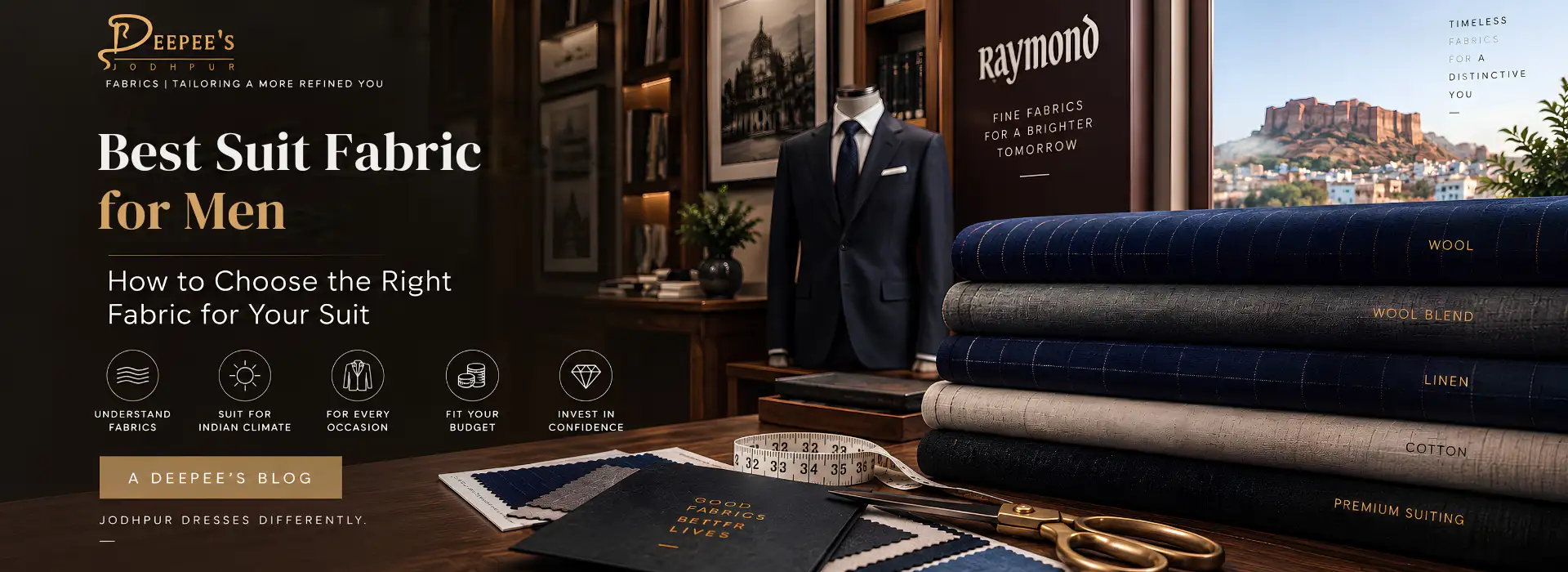
A good suit begins long before the first measurement is taken.
It begins with the fabric.
You can have an excellent tailor, a flattering cut and precise measurements, but if the fabric isn’t right for where, when and how you intend to wear the suit, something will always feel slightly off. It might look beautiful but feel too warm. It might be comfortable but lack the structure you wanted. Or it might be wonderfully luxurious but far too delicate for the frequency with which you intend to wear it.
That’s why there isn’t one universal answer to the best suit fabric for men.
The best fabric for a wedding suit may be completely different from the best fabric for an office suit. Jodhpur’s climate introduces another consideration altogether. Your budget matters, but so do your lifestyle, profession, personal style and how often the garment will leave your wardrobe. So before choosing a colour or pattern, start with the cloth itself.
What Should You Consider Before Choosing Suit Fabric?
When customers begin looking through suiting fabrics, colour is often the first thing that catches their attention. But five other questions deserve to come first.
- Where will you wear the suit? A daily professional suit needs to perform differently from one intended for weddings or formal dinners.
- How often will you wear it? Regular wear generally calls for greater durability and easier maintenance, while occasional suits allow you to explore finer fabrics.
- What climate will you wear it in? This is especially important when choosing suit fabric in India, where temperatures and seasons can vary considerably.
- How do you want the suit to fall? Fabric weight and construction influence everything from the sharpness of the shoulder to the movement of the trousers.
- What are you comfortable spending? Higher-priced fabrics can offer greater fineness, distinctive fibres and luxurious finishes, but the most expensive cloth isn’t automatically the most appropriate one.
Once those questions are answered, choosing between fabrics becomes considerably easier.
Wool: The Classic Suit Fabric
There’s a reason wool has remained central to tailoring for generations.
Good-quality wool has an unusual ability to combine structure with movement. It drapes elegantly, recovers relatively well from wrinkles and can be woven in different weights and constructions for different climates and occasions.
But the word wool covers an enormous spectrum.
A robust wool suitable for frequent business wear and an exceptionally fine wool intended for a luxury suit may look similar from a distance but behave very differently in practice. Finer fibres can produce a softer, more luxurious hand, while sturdier constructions may prove more practical for regular wear.
This is why choosing wool by reputation alone isn’t enough. The intended use still matters.
For a gentleman building a classic formal wardrobe, however, wool remains one of the strongest places to begin.
Wool Blends: When Practicality Matters Too
Pure fibres often receive most of the attention in conversations about luxury, but blends deserve considerably more respect than they sometimes get.
Combining wool with other fibres can change the performance, durability, weight, stretch, wrinkle resistance and price of a fabric. For someone wearing formal clothing regularly, those qualities can matter enormously.
A well-chosen wool blend can therefore be an excellent choice for office suits, formal trousers and frequently worn business clothing.
This is particularly relevant for professionals who aren’t buying a suit merely to photograph beautifully once. Their clothing has to survive sitting through meetings, travelling, long working days and repeated wear while still looking presentable.
Luxury and practicality aren’t always the same requirement.
A good wardrobe understands where each belongs.
Linen: Beautifully Imperfect
Linen has an entirely different personality.
It’s breathable, lightweight and visually relaxed, making it particularly appealing in warmer weather. It also wrinkles—and that’s not necessarily a defect.
The slight creasing and movement are part of linen’s character. A linen suit isn’t trying to look like a sharply structured boardroom suit. It feels more natural in daytime events, summer celebrations, resort settings and occasions where formality can loosen slightly.
For Indian summers, linen can be exceptionally attractive when the setting allows for it.
If you want razor-sharp structure from morning until night, however, pure linen may not be the first place to look. Linen blends can sometimes offer a useful compromise, retaining some of linen’s texture and breathability while improving structure and crease resistance.
Cotton: Comfortable, Familiar and Understated
Cotton suits occupy an interesting middle ground.
Cotton is familiar against the skin, breathable and generally less formal in appearance than traditional wool suiting. It can work particularly well for daytime occasions, smart-casual tailoring and wardrobes that don’t require traditional corporate formality.
The trade-off is that cotton generally doesn’t drape or recover from creasing in quite the same way as good wool.
That’s not inherently a disadvantage. It simply creates a different kind of suit.
If your idea of dressing well leans towards relaxed tailoring rather than boardroom precision, cotton deserves consideration.
Poly-Viscose and Modern Blends: The Practical Workhorses
Not every suit needs to be an heirloom.
Sometimes you need something that looks smart, performs reliably, doesn’t demand excessive maintenance and makes financial sense for frequent use.
This is where poly-viscose and other practical blends become useful.
They can offer good durability, relatively easy maintenance and accessible pricing, making them particularly relevant for regular office wear, uniforms, formal trousers and first professional wardrobes.
The quality of blends varies significantly, so fibre composition alone shouldn’t determine the purchase. Feel the cloth. Look at its finish. Consider its weight and how it falls.
A well-made practical fabric can be a smarter purchase than an expensive fabric used for the wrong purpose.
What Is the Best Suit Fabric for Indian Weather?
This is where international suiting advice can become misleading.
Recommendations written for London or New York don’t automatically translate to Jodhpur, Mumbai or Delhi.
Indian conditions require us to think more carefully about fabric weight, breathability, season and actual usage. For warmer months, lighter constructions and breathable fabrics become particularly valuable. Linen and appropriate blends can work well for relaxed tailoring, while lighter wool and wool-blend options allow customers to retain a more formal appearance. Winter opens the door to richer and somewhat heavier constructions, particularly for evening events and occasion wear.
But climate isn’t just about the temperature outside.
If most of your day is spent moving between an air-conditioned office, car and meetings, your requirements may be very different from someone who spends significant time outdoors.
The best fabric for Indian weather is therefore not a fibre. It’s a fabric chosen for your version of Indian weather
Choosing Suit Fabric for Jodhpur
Jodhpur makes that distinction particularly important.
For much of the year, heat is a practical consideration, so excessively heavy fabrics can become uncomfortable for regular daytime use. Breathability, manageable fabric weight and comfort deserve serious attention when building an everyday formal wardrobe.
At the same time, Jodhpur has a strong culture of weddings, ceremonial dressing and evening occasions, where more structured or luxurious fabrics have an entirely legitimate place.
This means one fabric doesn’t need to do everything.
A professional wardrobe might benefit from lighter, durable suitings for regular use, while a Bandhgala or wedding suit can justify something richer and more structured. Buying intelligently sometimes means not searching for the single perfect fabric, but choosing different fabrics for different parts of your life.
What Is the Best Fabric for an Office Suit?
For regular office wear, we’d prioritise four things: Comfort. Durability. Crease recovery. Versatility.
Your office suit should still look composed after you’ve been sitting in it for several hours. It should tolerate repeated wear better than an extremely delicate occasion fabric, and it should work across meetings, presentations and regular working days.
Wool and practical wool blends are strong candidates here, depending on climate and budget. Modern blended suitings can also make excellent sense for professionals who prioritise durability and straightforward maintenance.
Colour matters too. If you’re building your first professional suit, navy and charcoal are remarkably versatile. Medium grey is another useful addition. Subtle patterns can come later once the foundation of the wardrobe is established.
Your first office suit doesn’t need to be your most adventurous. It needs to be the one you can rely on.
What Is the Best Fabric for a Wedding Suit?
Wedding clothing has a different job.
It isn’t expected to disappear quietly into your working week. Texture, richness, colour and the way the fabric responds to evening light and photography can matter considerably more.
This is where finer wool, wool-silk combinations, textured fabrics and more luxurious constructions become interesting.
But even for weddings, don’t choose fabric in isolation.
A summer daytime wedding, a winter evening reception and a destination celebration require completely different thinking. Your wedding venue, season, silhouette and the number of hours you’ll be wearing the garment should all influence the final choice.
The best wedding suit is one that still feels good several hours after everyone has finished complimenting it.
Is Expensive Suit Fabric Always Better?
No.
This is one of the most useful things to understand before shopping for suiting fabric. Expensive fabric may use finer fibres, more complex constructions, premium raw materials or specialist finishing. These can produce extraordinary softness, drape and visual refinement. But better fabric and better fabric for you aren’t necessarily the same thing.
Imagine two customers.
- One wears formal trousers five days a week.
- The other wears a suit three times a year.
Giving both customers the same fabric recommendation simply because it’s the most luxurious option would make little sense. The first may benefit considerably more from a robust, comfortable cloth designed for repeated wear. The second can afford to prioritise fineness and luxury because durability under constant use matters less.
The smartest purchase isn’t always at the top of the price list.
Where Does Raymond Fit In?
This breadth of requirements is one reason Raymond continues to be relevant to Indian menswear.
Rather than existing at a single price point or for a single type of customer, Raymond’s suiting portfolio extends across practical blends, wool-rich fabrics and increasingly fine premium and luxury constructions. For someone building an everyday professional wardrobe, that breadth provides practical options. For someone commissioning a more refined suit, there are finer fabrics to explore. And for customers interested in exceptional cloth, the conversation can move considerably further into luxury.
At Deepee’s Jodhpur, we maintain an extensive selection of Raymond fabrics across affordable, premium and luxury categories, which allows the conversation to begin with your requirement rather than a predetermined price bracket. And importantly, purchasing fabric doesn’t obligate you to have it stitched with us. You can buy your selected Raymond fabric and take it to your preferred tailor, or choose Deepee’s bespoke tailoring if you’d like us to take the garment from fabric selection through fittings and finishing.
Fabric First. Tailoring Second.
A beautifully tailored suit is the result of dozens of decisions that most people will never see.
Fabric is simply the first.
Before worrying about lapel width, buttons, pockets or trouser breaks, spend time choosing the cloth that will carry all those details.
- Touch it.
- Move it.
- Ask what it’s made from.
- Think about where you’ll wear it.
- Consider how often you’ll reach for it.
- And don’t be afraid to choose something practical when practicality is what your life requires.
The best suit fabric for men isn’t whichever fabric happens to be the finest, most expensive or most fashionable.
It’s the fabric that understands the assignment.
If you’re exploring suit fabric in Jodhpur, visit Deepee’s to compare fabrics in person, including an extensive range of Raymond suitings from everyday options to premium and luxury cloth. Choose the fabric that suits your wardrobe—and decide what happens to it next entirely on your terms.
Frequently Asked Questions
Wool remains one of the most versatile traditional choices because of its drape, structure and range of weights. However, wool blends, linen, cotton and modern blended fabrics may be better depending on climate, frequency of wear, occasion and budget.
Lightweight and breathable constructions are generally preferable in warmer conditions. Linen, suitable blends and lighter-weight wool options can all work depending on the level of formality required.
For frequent professional wear, prioritise durability, comfort, crease recovery and ease of maintenance. Wool blends and quality blended suitings can be particularly practical, while suitable wool fabrics remain an excellent option for more traditional business suits.
No. Pure wool can offer excellent drape and refinement, but blends can improve characteristics such as durability, stretch, maintenance or affordability. The better choice depends on how the garment will be used.
Finer wool, wool-rich constructions, wool-silk blends and other premium fabrics can work beautifully for weddings. Season, venue, time of day and the desired silhouette should influence the final selection.
Not necessarily. Some exceptionally fine luxury fabrics prioritise softness and refinement rather than resistance to frequent wear. A more robust fabric can sometimes be the better choice for an everyday suit.
Deepee’s Jodhpur offers an extensive selection of men’s suiting fabrics, including Raymond fabrics across everyday, premium and luxury categories. Customers can purchase fabric independently or opt for Deepee’s bespoke tailoring service.
Yes. Fabric and tailoring are separate choices at Deepee’s. You can purchase your selected fabric and take it to your preferred tailor, or choose Deepee’s tailoring service if you want the complete fabric-to-garment experience.
Conclusion
Find the Right Suit Fabric in Jodhpur
Looking for the best suit fabrics in Jodhpur? Explore premium Raymond fabric in Jodhpur and a curated range of fine suiting materials at Deepee’s Jodhpur. Visit our fabric store at 2nd Polo, Paota C Road, Jodhpur (Raj.) and find the right fabric for your next tailored suit
For fabric selection, custom tailoring and sales enquiries, call +91 9530123489. Get expert guidance on choosing the right suit fabric and have your outfit customised to your preferred fit and style.