
How Should a Professional Suit Fit? 10 Details That Separate a Good Suit From an Average One

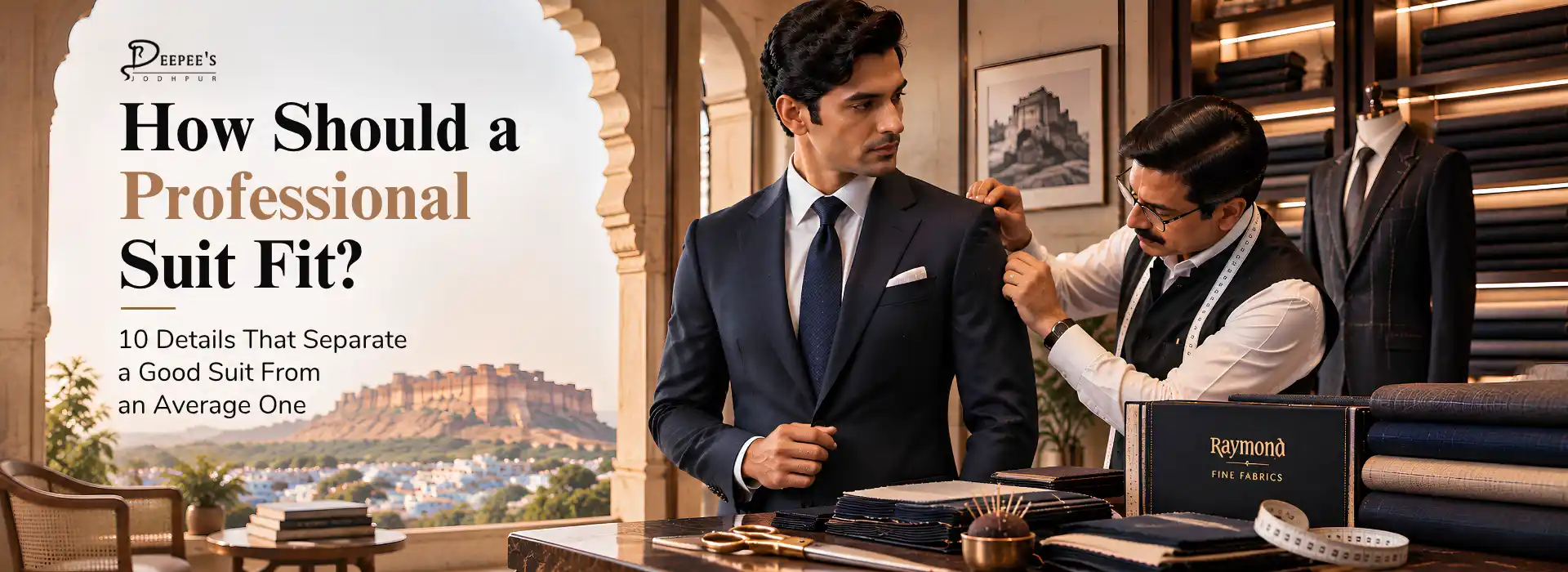
A professional suit has a fairly simple job: you should look well-dressed without spending the day thinking about what you’re wearing. If the jacket needs constant adjusting, the trousers feel uncomfortable every time you sit, or you’re waiting for the first opportunity to take the coat off, something isn’t right.
But if you’re getting a suit stitched, you shouldn’t need to become an expert in tailoring to figure out whether it fits well. You don’t need to know the technical vocabulary behind every adjustment. You only need to know what good fit should look and feel like on you. For officers, executives, businessmen and professionals who spend long hours in formal clothing, that distinction matters. A suit that looks impressive for ten minutes in front of a mirror is not necessarily a suit you’ll enjoy wearing through an entire working day.
So, how should a professional suit fit? Here are ten things worth paying attention to—and none of them require you to think like a tailor.
Quick Answer: How Should a Suit Fit?
A well-fitting suit should sit naturally on your shoulders, close comfortably without pulling, allow normal movement, show an appropriate amount of shirt cuff and have trousers that stay comfortably in place and fall cleanly over your shoes. Most importantly, you should be able to sit, walk, drive and work in the suit without constantly adjusting it.
The goal isn't to make the suit as tight as possible.
The goal is to make it look like it belongs to you.
1. The Shoulders Should Simply Look Natural
You don’t need to analyse shoulder construction.
Stand normally and look in the mirror.
The jacket should follow your natural shoulder line without appearing to extend noticeably beyond it or pulling tightly around it. There shouldn’t be obvious bumps, dents or collapsing fabric that immediately catches your attention.
If the shoulders look clean and proportional to your frame, you’re starting from the right place. This is also one reason professional tailoring shouldn’t be reduced to “slim fit” versus “regular fit.” Two men of similar size can have completely different proportions.
The objective isn’t to squeeze your body into a particular silhouette.
It’s to find one that works with it.
2. Button the Jacket—It Shouldn’t Feel Like a Test
When you button your jacket, you should still be able to breathe normally. That sounds obvious, but suits are often worn too tight because a close silhouette is mistaken for a good fit.
If the fabric is visibly straining around the button or you immediately want to unbutton the jacket because it feels restrictive, the fit probably needs attention. At the other extreme, the jacket shouldn’t hang around you without shape.
A professional suit should look composed when buttoned while still allowing you to move comfortably.
Fitted and tight are not the same thing.
3. Sit Down Before You Approve the Fit
This may be the simplest advice in this entire guide.
Sit.
Most people assess a suit while standing in front of a mirror. But if you’re buying it for professional wear, there’s a good chance you’ll spend a significant part of your day sitting.
Sit in a chair.
Move your arms.
Reach forward as though you’re working at a desk.
If you drive frequently, think about how the jacket and trousers will feel in the car.
A suit doesn’t need to feel like leisurewear, but it shouldn’t become uncomfortable the moment your working day actually begins.
For someone who wears suits regularly, sitting comfort matters more than showroom perfection.
4. The Collar Shouldn’t Constantly Need Fixing
You shouldn’t spend the day pulling your jacket back into place.
When standing naturally, the jacket should sit neatly around the neck and work comfortably with your shirt collar.
You don’t need to inspect this technically. Simply notice whether the jacket appears to sit where it belongs.
If something around the neck consistently feels awkward, looks untidy or makes you keep adjusting the jacket, mention it during your fitting.
A good tailor will understand what needs correcting.
Your job is simply to notice that something doesn’t feel right.
5. Your Shirt Cuff Should Be Part of the Look
When your arms are resting naturally, a small amount of shirt cuff will generally be visible below the jacket sleeve.
You don’t need to walk around carrying a ruler.
What matters is proportion.
If the jacket sleeves swallow your hands, they are probably too long. If a large section of shirt sleeve is permanently exposed, they may be too short.
The right balance makes the jacket and shirt look as though they were meant to be worn together.
It’s a small detail, but professional dressing is largely built from small details that don’t call attention to themselves.
6. The Jacket Length Should Feel Proportionate to You
Trends have pushed men’s jackets both shorter and longer over the years.
For a professional wardrobe, we wouldn’t chase either extreme.
The jacket should look balanced against your height, torso and legs.
This is particularly important for shorter or taller men, because blindly following a fashionable jacket length can distort proportions rather than improve them.
You don’t need to determine the correct length yourself.
Look at the complete silhouette.
Does your upper body look disproportionately long or short?
Or does everything simply appear balanced?
When tailoring is good, your eye generally notices you before it notices the dimensions of the jacket.
7. Your Trousers Should Stay Where They’re Supposed to
A professional working day involves enough small inconveniences already.
Your trousers shouldn’t become another one.
They should sit comfortably at the waist without requiring a tightly fastened belt simply to remain in place. You shouldn’t need to pull them up every time you stand.
At the same time, they shouldn’t feel restrictive when you sit.
This is particularly important because extremely slim trousers can look sharp while you’re standing still but become much less pleasant after several hours of movement, sitting and driving.
If you wear formal trousers frequently, tell your tailor how you actually like them to feel.
Some men prefer a closer silhouette. Others want slightly more room.
The correct answer is the one you’ll happily wear all day.
8. The Trouser Length Should Look Clean
Look down at where your trousers meet your shoes.
There shouldn’t be so much fabric collecting at the ankle that the trouser loses its clean line.
At the same time, professional trousers don’t necessarily need to be cropped simply because shorter lengths happen to be fashionable.
There are different preferences for how much of a break—the fold where the trouser meets the shoe—you want.
Again, you don’t need to learn the terminology.
Tell your tailor whether you prefer your trousers slightly shorter and cleaner or a little more traditional.
The finished result should look intentional rather than accidental.
9. You Should Be Able to Move Like Yourself
- Raise your arms.
- Sit down.
- Walk.
- Reach for something.
- Put your phone in the pocket where you normally carry it.
A tailored suit is still clothing. It has to accommodate a human being doing ordinary things.
This doesn’t mean a structured jacket will move exactly like a T-shirt. It won’t.
But there is a considerable difference between feeling appropriately dressed and feeling trapped inside your clothes.
This matters even more for professionals who spend long hours in suits.
If you have to behave differently because of what you’re wearing, the garment isn’t working hard enough for you.
10. After Ten Minutes, You Should Stop Thinking About the Suit
This is perhaps the most useful test.
When you first put on a new suit, naturally you’ll look at it.
You’ll check the mirror. Adjust the jacket. Look at the trousers. Notice the fabric.
But once you begin your day, the suit should gradually disappear from your attention.
You shouldn’t keep wondering whether the jacket looks right.
You shouldn’t constantly pull at your sleeves.
You shouldn’t think about your waistband during a meeting.
You shouldn’t rush to remove your jacket the moment you sit down.
A good professional suit lets you forget you’re wearing a good professional suit.
It simply does its job while you do yours.
Slimmer Doesn’t Automatically Mean Better Fitting
- This deserves its own section because it has caused a great deal of confusion in men’s tailoring.
- A slim suit and a well-fitting suit are not synonyms.
- A suit can follow the body closely and fit beautifully.
- It can also follow the body closely and be uncomfortable everywhere.
- Likewise, a slightly more relaxed silhouette isn’t automatically old-fashioned. Depending on your build, profession and personal preference, it may actually look more elegant.
- For professional clothing, we’d prioritise proportion over tightness.
- The suit should give your body shape without making every movement visible through the fabric.
- You are getting dressed for a working day, not standing permanently in a fitting-room pose.
Your Best-Fitting Suit Is Useful Information
If you already own a suit that you love wearing, bring it up when commissioning your next one.
You don’t need to know why it works.
Perhaps the trousers feel particularly comfortable. Maybe you like the jacket length. Perhaps it’s the only suit you can wear all day without feeling restricted.
Tell your tailor.
If you’re visiting a new tailor after moving to Jodhpur, you can even bring the garment with you if appropriate.
“I like how this fits.”
is extremely useful information.
So is:
“I don’t want my new trousers this narrow.”
Your previous clothes can communicate your preferences without requiring you to speak the language of tailoring.
Professional Fit and Wedding Fit Don’t Always Need to Be the Same
A suit designed primarily for an important occasion may reasonably prioritise a sharper or more distinctive silhouette.
Professional clothing has a different responsibility.
It has to survive repetition.
If you wear a suit from morning through evening, comfort begins carrying considerably more weight. If you sit for long periods, travel frequently or move throughout the day, the garment needs to accommodate that reality.
That doesn’t mean professional suits should be loose or conservative.
It simply means the suit should be designed for the life it will actually experience.
This is particularly relevant for government officers, executives and businessmen whose formal clothing may move between ordinary workdays, meetings and official functions.
One garment sometimes needs to do several jobs.
Can a Ready-Made Suit Fit Well?
Absolutely.
If your proportions align closely with a brand’s standard sizing, a ready-made suit may fit extremely well, particularly after minor alterations.
Custom tailoring becomes more useful when standard sizing repeatedly creates problems, when you wear suits often enough for small fit issues to become irritating, or when you simply want greater control over how your professional clothes feel.
The question isn’t whether custom is always superior.
It’s whether customisation solves a problem you actually have.
Fabric Affects How a Suit Feels Too
Fit isn’t only about measurements.
The fabric contributes to how comfortable, structured and wearable the finished suit feels.
A professional who wears suits frequently may need a different balance from someone commissioning a garment primarily for special occasions.
This is why, at Deepee’s, we prefer to understand the garment before recommending from our range of Raymond fabrics in Jodhpur.
- What are you making?
- How frequently will you wear it?
- Where will you wear it?
- What sort of feel do you prefer?
- What’s your budget?
Once those questions are answered, fabric selection becomes far more useful than simply asking for the most premium cloth available.
Frequently Asked Questions
A professional suit should sit naturally on the shoulders, close comfortably without pulling, allow normal movement and remain comfortable while sitting. The trousers should stay comfortably in place and fall cleanly over the shoes. You shouldn’t need to constantly adjust the garment throughout the day.
No. A fitted suit may sit close to the body, but the jacket shouldn’t visibly strain or feel restrictive when buttoned. Slim and well-fitted are not the same thing.
Suit trousers should remain comfortably at the waist without constant adjustment, allow you to sit comfortably and fall cleanly toward the shoes. The ideal silhouette can vary according to your build and personal preference
Trouser length depends partly on the look you prefer. Some men prefer little or no break for a cleaner appearance, while others prefer a slightly more traditional length. The important thing is that excessive fabric does not gather untidily around the shoes.
Yes. If you’ll wear the suit professionally, sitting is one of the most useful ways to assess comfort. Walk, sit and move naturally during your fitting rather than evaluating the garment only while standing in front of a mirror.
Not necessarily. The best professional fit depends on your proportions, comfort, profession and preferences. A suit should look refined without unnecessarily restricting movement.
Deepee’s Jodhpur offers men’s tailoring for professional and formal clothing, along with a selection of Raymond fabrics for customers who need both suiting fabric and tailoring.
If you already have suiting fabric, you can discuss the garment and tailoring requirements with the Deepee’s team. Customers looking for fabric can also explore the Raymond range available at Deepee’s.
Conclusion
Getting the Fit Right at Deepee’s Jodhpur
For more than four decades, Deepee’s has worked with men’s formalwear and tailoring in Jodhpur, from professional suits and trousers to Bandhgalas, Jodhpuri suits and occasionwear.
For professionals, we don’t expect you to arrive knowing what technical alterations your suit requires.
That’s our job.
Tell us what feels comfortable.
Tell us what hasn’t worked in your previous suits.
Tell us how frequently you wear formal clothing.
And tell us what your normal working day actually looks like.
If you need fabric as well, you can explore our Raymond collection across practical, premium and luxury categories. If you already own fabric, you can discuss your tailoring requirements separately.
Because how should a professional suit fit?
Well enough that people notice you look well-dressed.
And comfortably enough that, after that, you forget about it entirely.
Visit our fabric store at 2nd Polo, Paota C Road, Jodhpur (Raj.). For fabric enquiries, pricing and custom tailoring, call +91 9530123489.
Choose your preferred fabric and have your suit customised to your fit and style.